Connecting the dots: How using multiple AI tools can take your lead generation campaigns to the next level
The smart use of AI automates and optimises lead generation, from initial contact through to conversion.

AI has become indispensable by now. Everywhere you look, you see an icon asking what the local Agent can help you with. Often, this isn't necessary, or you find yourself trying to invent a problem for AI to help you with at that moment.
Because an Agent needs clear guidelines to provide reliable information, that is not always the best place to start. The real added value for the projects we specialize in lies in the targeted implementation of the right tools within a structured flow, where each step contributes to optimizing the final result. In other words: the sum is greater than its parts.
The objective
For our client, a distributor of smart-home products, we wanted to collect and nurture B2B leads more efficiently. Not by manually compiling lists or sending cold bulk emails, but by building a fully automated flow that:
- Finds relevant companies
- Enriches contact data
- Sends personalized emails
- Follows up on engagement
- Forwards interested leads to an AI-powered landing page with concrete price proposals
Fully automated. Fully scalable.
The workflow explained
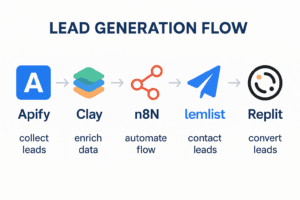
The power of this setup lies in combining specialized tools. Each has its own role in a logically constructed chain that runs from the initial contact to conversion.
Step 1: Apify – Collecting data at the source
We start with Apify to scrape a list of Belgian tradesmen. This provides us with basic information such as company name, website, location, sector, and in some cases even the email address. The tool itself doesn't use AI for this, but it does have smart input options to define the search location. To prepare for this, we use one of the well-known LLMs to define the exact coordinates of our target area.
Step 2: Clay – Finding the right contacts
For each company, Clay finds the correct email address if it wasn't already available, the name of the relevant contact person based on sector-specific parameters, and additional company info such as the number of employees and their LinkedIn profiles.
Step 3: n8n – Filtering and automating data
n8n receives the enriched data from Clay, filters out the irrelevant leads by having an AI agent with a custom prompt decide which ones do not meet our target audience criteria, and forwards the validated data list to the outreach platform for an initial contact.
Step 4: Lemlist – Sending personalized emails
In Lemlist, a warmed-up mailbox (using Lemwarm) is waiting to send a personalized email campaign to the new leads. Here, A/B testing is performed to continuously optimize engagement. That engagement can consist of clicks on links to a landing page and/or replies to the email, depending on the goal of the campaign.
Step 5: Replit – Smart landing page with AI form
When one of the CTAs in the email is clicked, the next step is ready to convert the lead into a customer: An AI-customized landing page that taps into the information we retrieved with Apify. Depending on the niche within the sector where the lead is active, tailored content is shown to spark the user's interest and encourage them to create an account and make a first purchase.
Why this works
- Relevant, warm leads with richer data
- Marketing and sales stay aligned
- Customers receive quick and personalized responses
- The workflow is reusable and scalable
It is no secret that AI has a major impact on everything we do these days. Yet, it remains crucial to take a critical look at the tools we deploy and to work with a clearly defined flow. This ensures that AI supports our work efficiently. Our core focus in digital performance marketing remains unchanged, but is strengthened by smart tools that continuously improve our results.
What’s in it for you?
Our flows are ready to use, can be deployed modularly, and are always kept up to date with the latest technology. Are you ready to take your lead generation to the next level with AI?