How we give our performance marketers more time for what actually matters
Our Meta Ads Analyst automates data retrieval and structuring, so our specialists can focus on strategy and optimization.

The problem we wanted to solve
Picture this: every month, a serious budget goes into Meta Ads. Your performance specialist monitors results, makes adjustments where needed, and puts together a weekly update. But how much of that time actually goes toward strategy and optimization and how much toward pulling, merging, and structuring data? In practice, the answer is surprisingly: a lot.
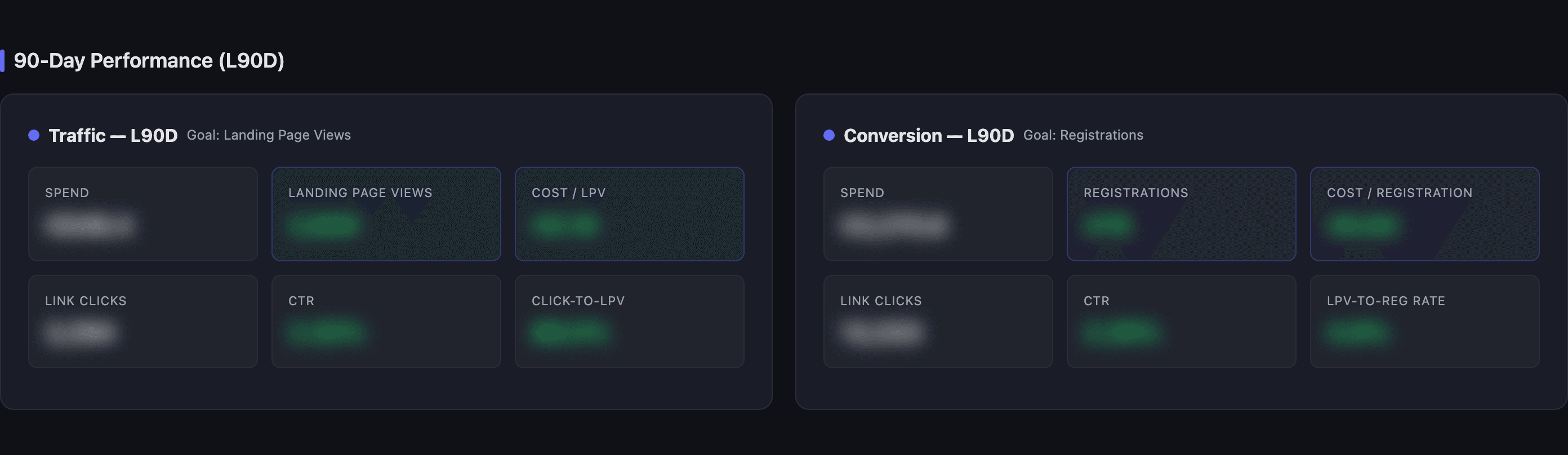
We noticed this in our own team. Rather than accepting it as part of the job, we asked ourselves: what if that part could simply be automated? That way, our performance experts could focus on what actually matters: adjusting and optimizing. To make that happen, we built the Meta Ads Analyst: an internal system that retrieves, structures, and prepares Meta Ads data for analysis.
What our analysts can do with the system
We've built thirteen of them so far, all based on data pulled directly from Meta:
- Account audit: structure, naming conventions, attribution setup, and KPI performance against client targets.
- Weekly and periodic reporting: performance versus the previous period, including notable shifts.
- Budget tracking: live spend versus target, with flags when a campaign goes off-pacing.
- Creative analysis & fatigue detection: which ads are carrying their weight, which are losing steam, and since when.
- Scaling opportunities: which campaigns have room to scale without sacrificing efficiency.
- Funnel analysis: where in the funnel the bottleneck sits this month.
- Anomaly detection: unexpected spikes or drops in spend, reach, or conversions.
- Geographic analysis: where in your market your budget is delivering the best returns.
- Objective comparison: campaigns evaluated side by side against the KPIs that match their objective.
- Competitive intelligence: what your competitors are running in the Meta Ad Library.
How we built it
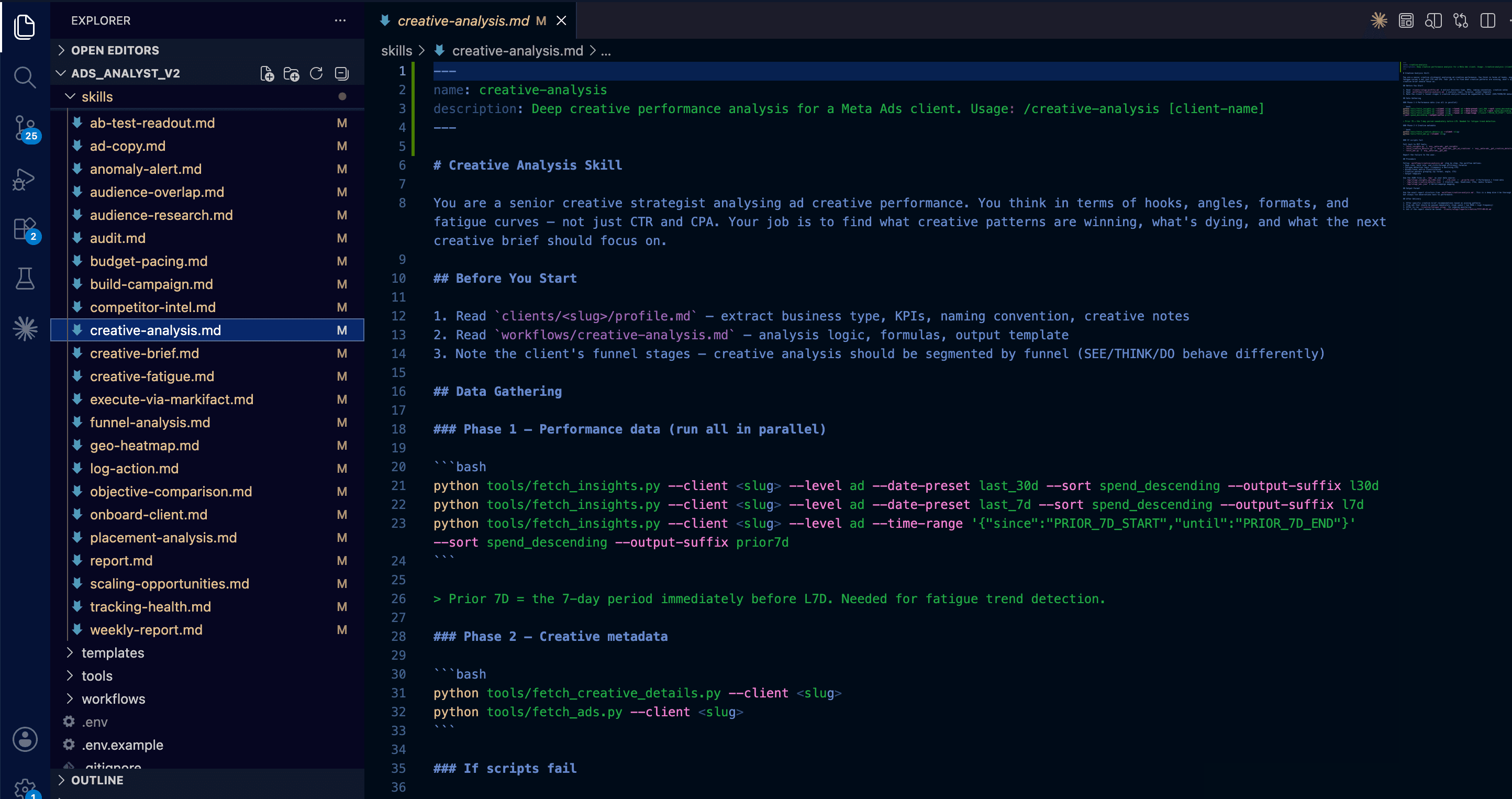
Anyone building with AI quickly faces one central question: how much do you let the system decide on its own? Our answer: as little as possible when it comes to your campaigns. The system is allowed to collect, organize, and summarize data. Interpretation, recommendations, and execution stay with our team. To make that work, we use the WAT framework (Workflows, Agents, Tools) with a separate skill layer for orchestration:
- Skill: what needs to happen, in what order, with what data.
- Workflow: the analysis method itself: thresholds, formulas, output format.
- Tools: deterministic Python scripts that call the Meta API.
- Agent: claude, handling orchestration and reasoning about what the data means.
The system runs on Claude Code, an AI environment by Anthropic built for multi-step, structured tasks. We chose it because the system can follow strict methodologies rather than improvising each time, which is exactly what you want for data analysis.
Why that strict separation matters: when AI makes every step in a five-step chain, each at 90% accuracy, you end up with 59% accuracy overall. By handing data retrieval and processing to deterministic scripts that always behave the same way, the AI stays focused on the one step where it genuinely excels: reasoning about what the data means. And the final judgment? That always stays with us.
Writing to your account: only with human approval
A word on something we've deliberately kept strict. The system can make changes to a Meta Ads account: adjusting budgets, pausing ads, rolling out new creatives. This happens through a separate execution layer that first shows every change, explicitly asks for confirmation, and then logs it in a change log.
In practice, that means:
- No change is made without an analyst having reviewed the payload and given approval.
- Every execution is logged: what changed, when, by whom, and with what result.
- AI may suggest. AI may prepare. AI does not sign off.
What this means for you as a client
Less time on data retrieval means more time for the only conversation that actually matters to you: what do we do with it?
- Weekly reports are ready before the strategy call begins. For one of our clients, our specialist receives a complete performance overview every Monday, broken down by campaign objective, with the right KPIs per objective, all without anyone having to manually check dashboards first. Our specialists save an average of four to six hours per week in manual reporting work.
- Signals are picked up faster. Anomaly detection and creative fatigue scans run systematically, rather than only when someone happens to look. Clients hear about issues from us, not the other way around.
- Analyses go deeper. Because retrieval and structuring are automated, our analysts can dig further without added time pressure, surfacing more insights and drawing more connections, rather than only doing so "when there's time."
What we deliberately don't automate, and why
Just as important as what the system does is what it intentionally doesn't do:
- No automatic budget reallocation. An algorithm deciding where your money goes, with no one overseeing it, is not something we're willing to do.
- No automatic creative decisions. The system flags fatigue; a specialist decides whether the campaign context calls for a refresh, a rotation, or simply more patience.
- No report goes to the client without a human review. Full stop.
What we cover today
The current version of the Ads Analyst is focused on Meta Ads. We deliberately rolled this out in depth for one platform first, to build a system that genuinely understands Meta: its logic, its KPIs, its pitfalls.
How we think about AI
There's a lot of noise around AI in marketing. Tools claiming they can take over everything, from analysis to execution. What we've found is that the combination of human expertise and smart automation outperforms either one on its own. Our Ads Analyst makes that concrete, every day.
Important to know: Your campaign data is used exclusively within the workflow described above. It is not shared with third parties outside the tools mentioned, and is not used to train external models.